| Church | Date | Time | Topic | Trigger quote | Prosperity |
|---|
Prosperity words (raw) is raw word frequency (includes "seed," "harvest," "increase" from ordinary Bible passages like the Parable of the Sower). NOT a measure of prosperity teaching — it's shown muted, for context only. See the verified Hard/Soft counts instead. Other lexicon columns are density = counts per 1,000 words; conditional columns count chunks where if_then_present is true. Descriptive — read the quotes before drawing conclusions.
Timeline — dominant lexicon family by week
Emphasis × counterbalance
Concentration — one dumb sermon, or a real pattern?
Texture — linguistic style by church
Colorado Springs churches: neighborhood, teaching, and emphasis
| Church | Zip | Median income | Prosperity (verified) | Gospel % | Preached on most |
|---|
What Prosperity: Hard and Prosperity: Soft mean
This is the most contentious section of the site, so it should be read before drawing conclusions.
Definitions are primarily informed by historian Kate Bowler's work on the prosperity gospel (Blessed: A History of the American Prosperity Gospel, Oxford University Press, 2013). Bowler describes prosperity theology as a movement organized around four themes: faith, wealth, health, and victory, built on the idea that faith, rightly exercised, obligates God to deliver material blessing. Scholars commonly distinguish Hard Prosperity from Soft Prosperity. Hard prosperity promises a guaranteed, transactional material return: give this, receive that. Soft prosperity emphasizes success, breakthrough, favor, or blessing without making the guarantee explicit.
Review of individual sermons also reflects a traditional evangelical approach to biblical interpretation. Promises made to specific individuals or covenant communities are not automatically promises to every Christian today. When sermons transfer those promises directly to modern listeners as expected outcomes, that transfer is considered relevant evidence when evaluating prosperity-oriented preaching.
Some readers may argue this is simply a disagreement over hermeneutics. Fair enough. But if promises made to specific biblical individuals automatically belonged to every Christian today, faithful believers would never suffer poverty, obedient Christians would not die young, and missionaries would never be martyred. The history of the church shows otherwise. That is why this project treats transferred promises as a distinct rhetorical move rather than assuming they are universal biblical promises.
When a moment is labeled Prosperity: Hard
A moment is labeled Prosperity: Hard when it promises an outcome that is:
- Material, meaning money, health, or status.
- Directed personally to the listener.
- Conditioned on giving, faith, or obedience.
- Presented as guaranteed ("will" rather than "may").
- Expected during this life.
When a moment is labeled Prosperity: Soft
A moment is labeled Prosperity: Soft when blessing or success language is milder, transferred from another biblical audience, hedged, or left undefined.
One editorial rule deserves to be stated plainly. When a promised outcome is left undefined but clearly points toward money, success, promotion, increase, or similar earthly gain, it is generally flagged. Undefined blessing language frequently functions as prosperity language in the hearer's ear even when it is not stated explicitly. Readers may reasonably disagree with that judgment. It is stated here so the methodology is transparent.
Example of a Hard label
One sermon taught:
"Give with the mentality of a seed. Your seed goes into your future and creates a harvest for you."
This meets the Hard definition because a return is promised to the giver, the return is conditioned on giving, and the outcome is presented as a reliable expectation. The sermon specifically presents the offering as a seed that creates a future harvest for the giver. While Scripture contains commands regarding generosity and tithing, together with promises attached to particular passages and covenants, the sermon presents this as a general promise to every listener. That extension of the biblical promise is what received the label.
Example of a Soft label
Another sermon described God's promise to Judah that after two difficult years they would again sow, reap, and enjoy the fruit of the land. The sermon then turned to the congregation:
"So if God told you, just trust me for "X" years. The "Y" year, you're going to be blowing and going."
This received a Soft label because a specific historical promise made to Judah is transferred into an expected outcome for today's listener. Scripture certainly teaches that God blesses His people. It does not promise every Christian Judah's specific timeline or restoration.
Example that received no label
One sermon quoted:
"Give and it will be given to you, pressed down, shaken together, running over."
Standing alone, that appears to support prosperity teaching. Read in context, however, the pastor was teaching Luke 6 exactly as Jesus intended: a passage about judgment, forgiveness, generosity, and mercy rather than financial return. Because the passage was handled faithfully and not turned into a promise of material blessing, no label was applied.
That example illustrates an important principle. The objective was never to identify as many prosperity examples as possible. The objective was to evaluate each passage in context, even when that meant clearing examples that initially appeared problematic.
What This Project Is
Colorado Springs Churches is an independent research project that analyzes the public preaching of Christian churches in the Colorado Springs area.
Its purpose is not to rank churches or declare winners and losers. Instead, it seeks to describe recurring teaching patterns using transparent methods and publicly available sermons.
Sermons were collected from public podcast feeds and church media websites. Whenever possible, supporting sermon excerpts are available so readers can examine the evidence for themselves.
Why Analyze Many Sermons?
Churches are not evaluated from isolated sermons.
Many preach through books of the Bible, while others use topical series. In either case, pastors make decisions about what to emphasize, which passages to spend time in, how Scripture is applied, and which themes are revisited over time.
Those choices shape what a congregation hears.
Rather than asking whether a topic appeared in one sermon, this project looks for patterns that emerge across months of public preaching.
What the Metrics Measure
Not every metric on this site is created the same way.
Some measurements are descriptive, such as word frequencies, thematic vocabularies, readability, and other language statistics.
Others require interpretation. Prosperity labels, for example, were reviewed manually using written criteria documented in the methodology. Supporting sermon excerpts are provided so readers can examine the surrounding context for themselves.
This Is Not Keyword Counting
That is the first assumption most people make.
Every sermon passage is analyzed in two ways.
First, each passage is examined in context. The analysis identifies things like conditional promises, who is asked to act, what outcome is promised, and whether Scripture is being explained or primarily used to support an existing point. A verbatim excerpt is retained with every result.
Second, nineteen themed vocabularies track recurring language. These word counts are flags, never conclusions.
The distinction matters because the same word can mean very different things. For example, seed appears when explaining Jesus' Parable of the Sower and when teaching that financial giving produces material blessing. A word count cannot distinguish those ideas. Reading the surrounding argument can.
Prosperity labels on this site were reviewed by hand. The software identifies candidate passages. A person reads each one in context before any label is assigned.
What This Project Does Not Measure
This project does not determine whether a church is faithful, spiritually healthy, or effective.
It does not measure pastoral character, discipleship, counseling, missions, church governance, or ministries outside the sermon.
It measures one thing.
What churches consistently emphasize in their public preaching.
Methodology
Audio was collected from public podcast feeds and church media websites. Sermons were transcribed with TurboScribe using sentence-aware settings, then divided into short passages. Claude analyzed each passage independently, identifying claims, conditions, promises, and handling of Scripture. Those results were aggregated to identify recurring patterns across churches.
The descriptive language metrics are automated and should be understood as indicators rather than conclusions.
Prosperity labels, however, were reviewed manually, one passage at a time, against a written definition. Some passages initially flagged by the software were cleared after review. Every published label links back to the supporting sermon text.
Future Work
The dataset will continue to grow over time. I plan to add more churches, expand the number of sermons analyzed for existing churches, and include additional Christian denominations.
The biggest limitation is not the analysis itself. It is collecting and organizing the source material.
Many churches publish podcasts with little or no episode metadata, requiring sermons to be identified and verified by hand before transcription. Others host sermons on Vimeo or similar platforms, where audio must first be extracted. Worship music is also removed before transcription so that song lyrics do not influence the results.
Much of this work is manual and often takes longer than the analysis itself. That is the primary reason some churches are not yet included or have fewer sermons represented than others.
As more sermons become available and additional churches are processed, the dataset will continue to expand.
Final Notes
This is not doctoral research, nor is it presented as such. The methods, code, and definitions are published openly so others can inspect, critique, or improve them.
The goal is to create a transparent resource that helps readers understand what churches consistently preach.
The conclusions are yours to draw.
Site Traffic
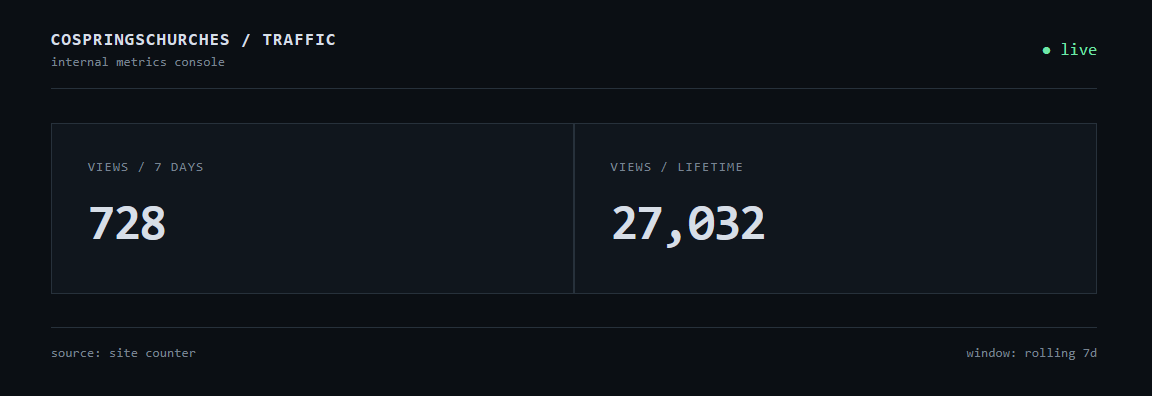
Loosely rolling data from the hosting service.